Showing posts with label sacred king. Show all posts

Friday, August 26, 2011

Chickens Running in All Directions (XII)
Who is a heavyweight? I mean a heavyweight in a charismatic way.

I know that every star of whatever brightness is believed to be a heavyweight. However, this is a suspect presumption. The twinkle of a star may be but a twinkle.

The charisma of a heavyweight calls back to my mind the office of the Sacred King, the mythological, but not always, figure of ‘ancient’ times. This was a man, and sometimes a woman, who did real things in such a way that he-she earned themselves a place in a nation-founding myth.

Before the founding myth there was no Sacred King or Queen to guide society beyond the mother, children, and wandering Son circle. The members of this group were so much into each other that they seldom fought with each other.

Nevertheless, this incredibly tight knot, which was bound by incest [might this have been the original Gordian knot?] was often visited by exceptions: unforgettable murders. The murder by Cain of Abel belongs to this genre. The war between kings Paris of Troy and Menelaus of Sparta for the living body of Queen Helen was likely due to the fact that Helen’s bed was too close to that of her brothers. Such intimate relationships have long been erased from the founding story, whether the Bible or myth. Nevertheless, the story is a near perfect example of pareidolia http://en.wikipedia.org/wiki/Pareidolia in story telling. One may see this type of pareidolia as deliberate in order to facilitate the sometimes repressed mind. The ‘Mind’ of Western society fits the bill.
Due to the unwelcome outbreaks of murder among the ‘original’ family, a larger society—if it was to maintain itself beyond the immediate intimate circle for any length of time—needed to discover a reason for being. Why indeed not return to the warm circle of babies nuzzling the breasts of their mothers, the family where sex among its own is unavoidable?

There are two ways in which an incest ridden family can avoid future outbreaks of fratri-cide.  One is 1) to leave the murderous event, the horror, and prevent a recurrence of itself as long as it remains part of a society’s living memory, but thereafter risk a repetition; or 2) repress incest.

The repression of incest fell to the office of The Sacred King.

The Sacred King did not repress (as we may think today) by using the police or a military, but by offering his life to death. By giving (voluntarily) his life to death, the king creates for ‘death’ its large D. The Death of the Sacred King creates such charisma that it equals and passes the charisma of two brothers trying to slay each other.

In other words, Why us, why is it that we must die, but not them; or why we and they, but not they over there are dying?

The cause of an enlarged social space is stimulated into being by two powerful factors:  1) the fact that sooner or later a murder not only does but must occur; and 2) that without a mediating resource, the default will prevail; in other words, catastrophes of a tragic nature will be frequent. Brothers will kill brothers as if no sisters had been born. Incestuous dreams lead to incest, and death of one of the brothers will be by the hand of the other, who found his brother’s legs entwined with the same legs that bore them both.
The story of incest may seem far from the political economy of Latvia. Actually, it is not. Latvia is as every-where-else in the 21st century. The economic disparity between the two brothers, the Oligarchs and the Populists, puts them at a catastrophic distance from each other. While one brother is a Populist with little education banging a whore who is also a Populist and most of the time stays unemployed, the other has so much money that he is called an oligarch, and the government runs scared of his big D….  

This is how the big D is weighed: Death on the one hand, Dick on the other. Both names are heavyweight, but the last one is for a laugh, no?

In Latvia the two brothers represent the nature of Latvian politics. One is a ‘non-existent’ Populists dreaded by the Oligarchs, because they are but a handful. The first mentioned are many, the last few. The Oligarchs are believed to be omnipotent, because America, London, Paris, and Berlin are on their side, while the others are said to be mere Populists, a Mob of sorts.

The Populists are the jelly on which the Tower of Babel, today owned by oligarchs, is built. We know the Tower of Babel to have crashed http://www.deldig.com/media_thumbs/180.jpg at least once before. Will it do so again? Does not the World and Latvian media speak as one out of a given system beyond which there is no other?

One sees this polarized relationship between the oligarch who pretends to the Prime Minister’s job of Latvia, and Clever John and Crazy Jane, the last being witch Ragana’s eldest daughter http://esoschronicles.blogspot.com/2010/03/eso-antons-benjamins-aka-jandzs-not_26.html , the former her pimp. Like it or not, Clever John and Crazy Jane happen to be Latvian citizens, too.

What does one Lembergs do for an encore after President Berzins, who—before being stirred into a passion for his country by high office—receives the highest pension in Latvia? If Ls 5000 monthly were to be divided by 10, the result is Ls 500—which is to say that ten families could afford to return from England to Latvia or will not leave Latvia. Clever John and Crazy Jane (Gudrais Jānis un Dullā Žane) get screwed only the way an incestuous son of Latvia can screw them. Then the oligarchs have the gall to say that the Latvian language is the most holy, and go kiss their “D”s if you don't believe it.
The Middle Class, the “successes” from among the Populists are close enough to their Populist roots to appreciate the difference, and  continues to kiss the oligarchs’ Blarney Stone  http://www.irelandseye.com/blarney/blarney.shtm till it shines and right can no longer be distinguished from wrong.

Friday, August 12, 2011

Chickens Running in All Directions (X)
The recent outbreak of hooliganism in London http://www.bbc.co.uk/news/uk-14449675 and in other parts of England, confirms the death of the traditional community with a vengeance http://www.bbc.co.uk/news/magazine-14487982 . Not that this is anything new or has not been known to happen before. Many historians of economy, notably Karl Polanyi (The Great Transformation, 1944), noted “the social catastrophe which followed the Industrial Revolution” http://en.wikipedia.org/wiki/The_Great_Transformation_(book) .

The social catastrophe of the Industrial Revolution was gradually arrested and a kind of temporary society reestablished in place of the traditional community. If before the arrival of the piston engine “…the self-sufficing household of the peasant laboring for his subsistence remained the broad basis of the economic systems…” (ibid), these systems were soon transformed into ones that turned the substance of its labors, labor including, into money.

Moreover, if before the arrival of money as the chief determinate of value, the community had been held together by the limits imposed by slow mobility (the horse, the sail, and objectified land), social rituals established over long periods of time, and the founding violence of the arch-Christian world (later to become neo-Christendom), the arrival of money commoditized even violence. Some of the first great wealth of our times was made by financing wars.

War is not a new phenomenon. We only have to recall the Vikings, who roved or sailed to distant lands and pillaged peaceable villages located far upriver of those lands. Indeed, such wars preceded the times of roads, because once the only ‘roads’ that were were rivers or paths along seashores. However, these early wars differed significantly from the wars of our time. While no one to this writer’s knowledge has called these early wars ‘fascist wars’, this is what they were, if we understand that  fascism http://en.wikipedia.org/wiki/Fascism_and_ideology can stand for socialism on behalf of small homogenous http://en.wikipedia.org/wiki/Homogeneity_and_heterogeneity  communities.

No doubt, early communities were also more or less democratic in the sense that individualism as such was non-existent or was barely perceived as such. Moreover, early communities probably sustained a dual system of self-governance: that of the sacred King being buttressed by so-called community of Elders.

The Sacred King was the scapegoat who legitimized the community by confirming through his death (real, ritualistic, one or both) the community’s will to be (as if to say: ‘The community is so important to me that I am willing to die for it’). The elders of the community (early bureaucrats) were then able to exploit the charisma of the death in an administrative way. Usually, such an ‘administration’ was by way of instituting common gods, ritualistic observations, distribution of supplies in times of emergency, and a network of messengers who distributed such summons as the Sacred King and the Elders issued in the name of the community. The community, often misnamed ‘tribe’, was generally visualized as a totem.

[The name of the Sacred King was probably John (Janis, Ivan, Huan, Jean, Dion, etc. The name probably derives from the name ‘gans’; re, herdsman. This is why the herdsman, also the Sacred King, is often identified with a lamb.]

Small community fascism expanded, after the great movement of communities from the East (perhaps originating in some climactic cataclysm) came up against the shores of the Atlantic in the West. With oceangoing ships not yet invented, many of the migrants settled as households (self-contained subsistence level economic units). Relatively peaceable communities at their inception, the governments of the communities—the Sacred King and Elders—soon came under the pressure of violence.

For one, the Vikings (and their like) had more prey (settlements) at hand, which they could attack; secondly, the relative vulnerability of a settled community vis-à-vis a gang of marauders increased the role of the messengers. With the arrival of violence, the role of these messengers was transformed. Traveling armed with a stick, we know them to this day as Gendarmes http://www.youtube.com/watch?v=B_Upljy3gks&NR=1  and Janissaries http://www.youtube.com/watch?v=ackK2GP8mCk + http://www.youtube.com/watch?v=opac9IGV8fM&feature=related .

The proto-Latvian communities had their Jahnihshi (Jānīši) or Johns, too. A Johns Festival song on Midsummer’s Eve or Johns Eve sings of this community’s guardian: “Ai, Jonny, son of the Sun!” Of course, today the word ‘Sun’ is replaced by the word ‘God’’. This is one of the ways that a small community is joined to the empire. Or could it be that one empire, the East, was exchanged for the empire of the West?

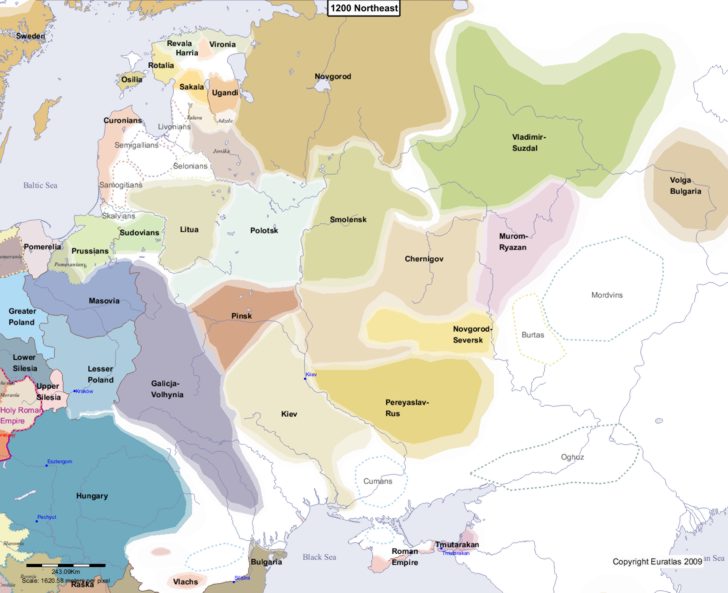
Yes, of course. I have frequently mentioned the 1209 attack by Bishop Albert’s knights (of Riga) against the proto-Latvian king Visvaldis and the city of Jersika (Jerusalem), which was located in what is now eastern Latvia. Situated on the left bank of Daugava (Jaunava?), Jersika was but a portage away from the Volga, whence the Black Sea and the Orient was wide open.
Without going through the labyrinth of proto-Latvian history (I do that in my earlier blogs), let us allow ourselves the fantasy of joining the 12th and 13th centuries in proto-Latvia to our days.

Today the Johns Festival on Midsummer’s Eve is famous for drunkenness by disoriented Latvians or summer concerts beginning with a Spanish song. John himself has been scandalized and was removed to heaven to sit on his hands there centuries ago.

Following a brief period of independence, 1918-1939, Latvia was occupied by the Soviet Union and administered on its behalf from 1940 until 1991. Since 1991, after undergoing brain massage by shock and awe capitalism, Latvia is an invalid sovereign country presided over and administered by a President, who cannot escape having a conflict of interest and being under suspicion of being a proxy of Western banks. The same goes for the Finance Minister. Almost everyone pretends that this is not so, but perhaps as many as 20% of Latvians have left the country to work abroad. This ought to serve as proof of incompetence, failure, and ‘sovereign’ power sans charisma.

Sunday, January 30, 2011

The following blogspots center on a variety of subjects, which I have initiated. You are invited to look and respond.
http://esoschronicles.blogspot.com/ Not-Violence main subject
http://melnaysjanis.blogspot.com/ Temple of Janis (John) site
http://the-not-voter.blogspot.com/ Arguments for systems change
http://the4thawakening.blogspot.com/ Sacrificial crisis in Latvia

I suggest you look at the links imbedded in these blogs or at the end of the blog as an integral part of my argument.  * text between [ ] is not part of quote.
The 4th Awakening

39 John Mocked Again (1)
© Eso Anton Benjamins

Following the removal in 1940 of the K. Ulmanis regime by the Soviet Union and Ulmanis’s failure to self-sacrifice himself in the name of the Latvian community (or state), the authoritarian president

1.     failed himself;
2.     diminished Latvian confidence in themselves;
3.     mocked the resurrection of Johns by confirming their death;
4.     confirmed the continued rule of the pseudo democratic elite;
5.      kept the idea of monarchy as government in continued disgrace though
        made a step in its direction.
All of the five points above are closely related, which is why the word “mocked” is the active verb that unites them all.

This blogger has already argued that John was long ago mocked and diminished by the secular elites, when they called him “pagan”, which word derives from pa-Yan, a word that attempts to diminish the meaning of Yan (John), the son of the Goddess Sun. The mocking tone brilliantly shows its colours in Mozart’s opera “Die Zauberfloete” and the well known song by Papagena and Papageno.

If it is true that the Herrnhuters, also known as the Moravian Brotherhood, taught proto-Latvians (~1729 - ~1740) choir singing in order to recruit them to their ranks, it is more than likely that they found among the war (Great Northern War, 1700-1721) demoralized proto-Latvians preexisting cultural and social infrastructures on which to base their efforts. The moral rebuilding of the proto-Latvians, while no doubt changing their perception of themselves (they largely forgot the Sun as their Dearest Goddess), brought back into the light many old traditions. Therefore, the now nearly forgotten Johns Songs (YouTube  stands as an example of their dearth), once as special to the Latvian Midsummer Johns Festival as Christmas songs are to the festival of the winter solstice, were not only preserved, but implicitly continued the Arch-Christian tradition of Christianity here and now rather than in a Neo-Christian no-place called heaven.

During the life time of K. Ulmanis (1877-1942), Johns Songs were still widely known and widely sung. One did not yet have to have a “cultural organizer” to misinform the celebrants that the Johns Festival was better known as Lihgo Festival (literally a “halleluia” festival) at which no one felt like halleluing. Though the Bear Wrestler had replaced John during that time as the Latvian hero, the new hero still had enough of the old one left in him for a full throated song.

In any event, when Karlis Ulmanis felt that Latvians had to be rescued from tearing themselves apart in a parliamentary and “democratic” Latvia by presuming himself to become their leader, he took upon himself the responsibility of a community generating self-sacrifice. Alas, he had never heard of such a thing, because no Western head of state—ever since the guillotining of the French KingLuisXVI during the French Revolution—had ever even thought of leadership that way.

Therefore, when Soviet leader Stalin challenged Ulmanis and “his” Latvian-Latvians, Ulmanis failed himself and the Latvians. In fact, such a failure of leadership was repeated by the “bloody” Stalin, who on his death bed yet tried to kill his doctors rather than sacrifice himself. Hitler did no better, because he killed himself only because he wished to avoid being hung by the Western Allies. The idea of the Sacred King was only a memory limited to poets. Even among them, he is more often remembered as the Fisher King, one lamed by a wound in the groin and unable to move unaided.

What is it that lamed not only Ulmanis, but has for so long (way before the French Revolution brought down Louis XVI) lamed all governments East and West?

Though Rene Girard argues so perceptively about the phenomenon of the scapegoat, and how human beings have no built in mechanism that checks violence (as it operates among some animals)—which is why there is a need for one time “generative violence” to establish rituals of peace—his failure to perceive Neo-Christianity (in his case Catholicism) as the institution that inhibits and lames men’s minds and forces them into inaction through the exercise of permanent violence (the hidden mailed fist), short-circuits his own break-through. Girard condemns Arch-Christianity in no less severe terms for its practices of self-sacrifice than did his Neo-Christian forebears whose violence instilled such fear in common man of the governing “elites” that it stopped the proper functioning of the mind of even the elites themselves. While the Neo-Christians have “apologized” for the violence of their “religion” and have promised to do so no more, the damage inflicted enabled the now long ongoing catastrophe of military-secular rule.

The pseudo or romantic democracy that has ruled the world, the West particularly, is a devastating farce for the planet and humankind. Of course, no major power or empire is going to shift their thinking until their ship of state falls and shatters. It is different and so much sadder when the small powers, the small communities and states such as Latvia, buy into the Western mindset. It is absurd of the Latvian politicians to insist that they are oriented toward the West, not the East, when the East is as Western as the West, and there is no threat from either, but the romantic system both now cultivate.

The Vatican is a monarchy, and so are Anglican England, and all milquetoast Lutheran archbishops. As Rene Girard writes: “What might be [is] concealed here is the desire to sacralize oneself and make oneself godlike—which quite clearly harks back to the illusion traditionally created by sacrifice.” In other words, fear the illusions of your enemies and let a few more million men die, which is all the more reason to procreate irresponsibly.

The Story of Crazy Jane and Clever John, Part 3
(…story begins at blog 15)

Clever John looked down and replied: “As large as a dead horse’s eye.”

As soon as Clever John had finished the words, the raven flipped on her back, and despite the hold that Clever John had on her feathers, he fell off her back.

Clever John fell for a long time it seemed. He finally fell on a large sandy dune by the sea. He was quite knocked out. However, wouldn’t you know it, he had fallen right on top on a large hoard of gold. Moreover, his fall had dug a large crater, which is why the gold was there all shiny and bright for his eyes—as soon as he woke up.

(To be continued.)

Asterisks & Links of Interest

* text between [ ] is not part of quote.

Unchanged Feature: What is reality, what is myth?

Changing Feature: In the preceding posts, I started a compilation of video clips, which when seen as a linear sequence tell a story in a context which I hope will become apparent. No, I do not yet know where it is going to lead. This is a story with no end. If it began in the past (it must have), it is now moving parallel to the day we live in. Watching the film may or may not contribute to your understanding of my meaning. Put this clip as a tail to your communication so http://news.google.com/nwshp?hl=en&tab=wn others may see. The origin of this post is at http://the4thawakening.blogspot.com/ 

Friday, November 5, 2010

Full or partial entries of my blogs may be found at LatviansOnline http://latviansonline.com/forum/ + Forum Home + Open Forum – The 4th Awakening. If you copy this blog for your files, or copy to forward, or otherwise mention its content, please credit the author http://esoschronicles.blogspot.com/, http://melnaysjanis.blogspot.com/, http://the-not-voter.blogspot.com/ or http://the4thawakening.blogspot.com/

I suggest you look at the links imbedded in these blogs or at the end of the blog as an integral part of my argument.
The 4th Awakening

10 The Devaluation of Latvos
The reduction of the Children of Johns to pa-Yanhood (now generally called “paganhood”) is evidence of what a violent, aggressive, and persecuting ego does. Such an ego belonged to forces of the West, which is not to say that it belonged to the Order of Teutonic Knights only.

The persecution began long before the Teutonic Knights came on the scene in Livonia. It was part of the movement of the princes of the world to shatter the hegemony of the old kingdom under the sacred king and capture a piece of its land for themselves. In the English speaking world, the famous moment of power transfer is the Magna Carta (1215). Joan of Arc (1431) saved the French king from his feudal aristocracy, which remained under his control, more or less. However, the feudal aristocracy fell with King Louis XVI’s head (1793) in the French Revolution. More about this paradigm shift in a future blog.

We may effectively translate the persecutions initiated by the West by perceiving them as the pursuit of positivism. The persecution advanced (openly, but pretending invisibility) on the king’s castle stealthily—as the story of the moving forest in Shakespeare maintains. The killed (cut down) forest hid Neo-Christian missionaries, who were sneaking up to the king and his people with the “good news”.

[The people of Livonia received the good news several times over. The first time probably was the attack of the Teutonic Knights under the flag of Neo-Christianity on Jersika in 1209. There are several contour maps of such forced conversions available. One is sketched right here by these blogs of course. There is also the so-called “Bloodlands” (click on ‘audio' version.

In 1209, Bishop Albert of Riga, attacked Jersika (Vis=All; valdis=ruler). The bishop defeated Visvaldis, brought him to Riga, humiliated him before the public, took away most of his land, and sacked him beyond recovery when he tried to rise a few years later.

The attack on Visvaldis coincides with the crusade of the Pope Innocent III against the Albigensians in southern France in the same year, 1209. While it is unlikely that seven hundred years later we will discover a label with “proof” written on it, it is equally unlikely that the date of attack was an accident.

1209 was a fateful for the Latuous or Latvos. The land Jersika was heir to was seized by a neo-Christian crusading order, the Teutonic Knights, and added to territory called Livonia. This land has remained out of reach of its natives to this day if one includes among the natives the common people. The Commons or Populists were and are kept in the dark. One but has to note that the founding event of modern Latvia (1918) had only one photograph of it made public, and the future president was not in attendance at the founding event. Like the “Lihgo” flag, the avoidance of mention of these details obscures the fact that the Constitution of Latvia (Satversme) was never designed to facilitate greater hegemony.

In any event, 1209 was a time when Livonia was covered by forests (today Latvia has no original primal forest left), and the Jersikans had no problem disappearing among the trees. Pursuit was difficult if nigh impossible, because in those days there were no roads or bridges, only waterways.

Before the attack from Riga, king Visvaldis had been in a strategically advantageous position. His kingdom of Jersika straddled the River Daugava, and he taxed all the boats and ships passing through. Indeed, if the reader takes a closer look at the map, he-she will note that access to Riga and the bay to the people of Jersika is cut off as if it has been taken from it. In other words, Riga most likely was not founded on unoccupied land or over a fishermen’s village, but was taken from a people, many of whom lived far inland. Indeed, because of the higher water level in those days, Riga was located further inland, closer to what the map shows to have been the likely territory of Jersika.

We may guess that the inhabitants of Riga (or Līga) before its occupation were—as most heads or deltas of navigable rivers tend to be—cosmopolitan, mixed blood, livs, ests, semigalians, latgalians, slavs, and so on. They do not appear to have left much evidence of their times. However, if they were living in wood shacks (at that time the forest engulfed, indeed was identified with the land), they probably lived along the banks of the Daugava River.

The theses of what happened to the inhabitants of Jersika or the Jersiks leaves us entertain the idea that the descendants remained in the same geographical area. The Livs were effectively wiped out only by the Great Northern War (1700-1721). Very likely some Livs were among the Herrnhuters who wrote Ludwig those nice letters about identifying so much and sincerely with the blood of Jesus.

The landscape of Livonia began to change dramatically only after the 16th century. The Latvians today like to call themselves a peasant (zemkopju) nation. Nevertheless, the time the Latvos could legitimately call themselves “single farm” (viensēta) dwellers did not arrive until about the 16th century or later. It was about this time that the barons (they owned about 70% of forests in Livonia) cut down most of the trees about their manors and sold them to Swedish and other builders.

In due course, the Latvos were forced to become farmers and abandon their forest traditions  forest traditions. As a people deprived of a say over the fate of their forests, the Latvos became exposed and vulnerable to attacks by military drill formations, which on open field had the advantage. There was no longer sufficient forest left behind which a Latvos could hide and be on roughly equal terms with the enemy.

Had similar deforestation occurred in fledgling America, Paul Revere's famous ride would have ended in a New England ditch rather than New England farmers beginning a successful Revolution against the British and their redcoats. Interestingly, Paul Revere was the son of a French Hugenot. The name Herrnhuter and their activities in Livonia may not have been unfamiliar to him.

Asterisks & Links of Interest
Jaņdžs0 comments