Showing posts with label Riga. Show all posts

Wednesday, April 13, 2011

Once the Wormeling scout escaped the Riga pils compound, he reconoitred Riga proper. St. Peter's church was one of his first stops, then a flower shop, then the Latvian Saeima building. He had some important questions that he wanted to ask the elite body of thinkers and lawmakers.

As the viewer can see, to have a better look, this Wormeling scout had to ask a passer by to raise him up off the street so he could see St. Peter's better.

Unfortunately, he did not get to see the gold plated rooster at the top of the church.


The next stop for Hairy Harry was a Riga flower stand. There had been no flowers in the refrigerator in the Riga pils basement.

Hairy Harry was happy to see all the colors and thought that in the future he, too, could come paint himself either blue, or yellow, or red, or orange.

Somehow Hairy Harry got lost. He wandered through the streets of Riga until he came upon a sign that he definately wanted to pose in front of. The sign had been painted or drawn or something by a well known Latvian cartoonist Maris Bishofs.

Hairy Harry had first seen the artist's cartoons in the New Yorker. Yes, indeed, Wormelings get around. Rumour is that they had first cousins who were born in the basement of the White House in Washington, D.C.

The artist had written above his drawing the following (translated from Latvian): "There may also be such monuments about which pigeons are allowed to roost.."

Then Hairy Harry found his way to the Latvian Saeima. It is not far from the Riga pils (castle). A sign on a street corner gave some kind of warning. It showed what is commonly called "a red brick". The Wormeling wanted to get a closer look of it.

The sign suggested that one could pass only with some kind of special permit. The question was what kind of permit. Was it a passport that showed that Hairy Harry was a Latvian?

Hairy Harry was not sure if the fact that he was born of a Latvian mind qualified him for Latvian citizenship.
Who kne the answer?

The best way to find out was to stand in front of the entrance to the Latvian Saeima and ask someone.

"Is this where I apply for my Latvian passport?" Hairy Harry asked a beautiful Latvian blond.

The blond was busy talking to her friend, and since a Wormeling is as thin as paper did not notice him.

"Oh, well," sighed Hairy Harry, "maybe the next time."

Monday, January 31, 2011

The following blogspots center on a variety of subjects, which I have initiated. You are invited to look and respond.
http://esoschronicles.blogspot.com/ Not-Violence main subject
http://melnaysjanis.blogspot.com/ Temple of Janis (John) site
http://the-not-voter.blogspot.com/ Arguments for systems change
http://the4thawakening.blogspot.com/ Sacrificial crisis in Latvia

I suggest you look at the links imbedded in these blogs or at the end of the blog as an integral part of my argument.  * text between [ ] is not part of quote.
The 4th Awakening

40 John to be Mocked Again? (2)
© Eso Anton Benjamins

For over twenty years now Latvia has endured a failed statist government disguised as a parliamentary democracy. In the preceding blogs I have traced some of the cultural and social mechanisms that have been contradicted by the current statist model, which has necessarily resulted in a schizophrenic and thus sick and failing state.

One of the chief hindrances to cooperation between the state and the citizens has been the surreptitious destruction by the state of the rural habitat of the nation in favor of one or at most a few urban centers.

The mass exodus of Latvians in search of jobs elsewhere not only illustrates the abandonment of the traditional “land” of the people, but the Latvian statist government at work. While on the one hand the government has painted itself as a supporter of Latvia for Latvians by exclusionary activity against those who cannot pass a test that proves that they can speak the Latvian language, which spells the government as jingoist, said jingoism has serves the government as a tool in the consolidation of its urbanite orientation.

The loss of possibly half a million people in twenty years [I am counting not only the 300,000+ emigrants, but the demographic loss due to dramatically lowered birth rates (1990=38,000 vs 2010=19,000) and increasing number of pensioners] has virtually guaranteed that by 2050 the total population of Latvia (baring an influx of ‘guest’ workers) will be 1.3 million or less in place of the current 2.2 million inhabitants.
One frequently hears that about a hundred years ago, Riga, the current capital of Latvia, was the third largest city in tsarist Russia. This statistic is brought out by many as if to forecast the future of the now dilapidated and shrinking Riga. True, this glorious past of the city was not brought up (as far as this writer knows) at the extremely boring “foreign policy debate” at the Latvian Saeima a few days ago (27/1/2011). On the other hand, no one suggested that growth is something that Riga could expect. At best, a former Prime Minister Shkhehle (Šķēle) argued for a federalized Europe. No one brought up the possibility that in the future, Riga could be the capital of the European Union instead of Brussels—if the EU were to include Russia.
In short, the statist (and static) government of Latvia is preparing the future of Latvia by imagining itself as the periphery of Europe rather than its centre. To bring its policy of failure to its abysmal conclusion, the Latvian people have to be in effect destroyed. The Latvian government—incidentally with the cooperation of Brussels—is rather successful from this point of view.

How can Latvians overcome the fears instilled in them by their statist government and forge themselves another, a more creative future?

In my previous blog, I spoke of Karlis Ulmanis failure to close the “sacrificial crisis” brought to Latvia with the occupation of Latvia by the Soviet Union. [The earlier sacrificial crisis was closed by the sacrifices of Latvia’s soldiers during WW1.] I suggested that President Ulmanis failure to sacrifice himself in protest of the Soviet occupation failed Latvians not only seventy years ago, but failed to look into the future which is now. Now Latvia has lost its sovereignty in a financial sense, the people in the countryside are preparing themselves for yet another mass exodus (if the rest of the European economy holds up), the country is demoralized to the point where policemen are turning robbers and shooting other policemen dead, debates in government circles are a safe bet to be duds, and people have been ‘dumbed down’ to trust a parliament that in its myriad self-contradictions is both statist and inert.

The ongoing “sacrificial crisis” (failure to lead by example among others) may of course be seen as an opportunity. If such an opportunity is to become real, there has to occur a major earthquake within the statist government. How is this to be done, when the parliamentary Saeima, the popularly unelected ministers and president, all appear to be of the belief that government is modeled on now proven failures, re: Plato’s “earthborn” ruling class, the boyars of the countryside seizing the city for themselves; or Aristotle’s kinship originated State by way of family to community to State. Neither of the two philosophers suggests that the State is the result of freedom in a state of chaos (libertarian?) brought together into a community by self-sacrifice, what I have argued to be not-violent self-sacrifice [see esos chronicles].

The failed presidency of Karlis Ulmanis, which left behind a demoralized people, nevertheless points the way to the solution, because the failure of self-sacrifice by the president is as evident as are evident the horrific consequences to the Latvian people and the State.

In other words, the piece of coal in the pie that in the days of old chose the one who would sacrifice appears to point at the milquetoast president of Latvia today. When Karlis Ulmanis seized the reigns of Latvia by coup de tat in 1934, he took upon himself all the consequences of that deed. His failure to meet all of the demands of his Presidency (which from a theoretical point of view may also, paradoxically, be called the rule of a Monarch, not impossibly a Sacred Monarch) now rests with the head of the Latvian State. That is to say, the saying “One for All and All for One” today rests with said One. The alternative is that of a federalized state, an administrative periphery of the EU, stripped of its identity much the way it is stripping itself of its citizenry.

The Story of Crazy Jane and Clever John, Part 3
(…story begins at blog 15)

Clever John fell for a long time it seemed. He finally fell on a large sandy dune by the sea. He was quite knocked out. However, wouldn’t you know it; he had fallen right on top on a large hoard of gold. Moreover, his fall had dug a large crater, which is why the gold was there all shiny and bright for his eyes—as soon as he woke up.

How did the gold get there?

(To be continued.)

Asterisks & Links of Interest

* text between [ ] is not part of quote.

Unchanged Feature: What is reality, what is myth?

Changing Feature: In the preceding posts, I started a compilation of video clips, which when seen as a linear sequence tell a story in a context which I hope will become apparent. No, I do not yet know where it is going to lead. This is a story with no end. If it began in the past (it must have), it is now moving parallel to the day we live in. Watching the film may or may not contribute to your understanding of my meaning. Put this clip as a tail to your communication so http://www.youtube.com/watch?v=fWaLL9Gyees&feature=related others may see. The origin of this post is at http://the4thawakening.blogspot.com/ 

Monday, December 6, 2010

Full or partial entries of my blogs may be found at LatviansOnline http://latviansonline.com/forum/ + Forum Home + Open Forum – The 4th Awakening. If you copy this blog for your files, or copy to forward, or otherwise mention its content, please credit the author http://esoschronicles.blogspot.com/, http://melnaysjanis.blogspot.com/, http://the-not-voter.blogspot.com/ or http://the4thawakening.blogspot.com/

I suggest you look at the links imbedded in these blogs or at the end of the blog as an integral part of my argument.
The 4th Awakening

18 Clever John as Fearless proto-Latvian (1)

The Story of Crazy Jane and Clever John
(© Eso Anton Benjamins) (…continued; beginning at blog 15):

When Clever John and Crazy Jane returned from Sun Mountain to The Old Witch’s Inn Clever John fell into bed as soon as he reached it. He shut his eyes and slept until it was time to go look after his mare Rozinante. It was evening.

The six brothers of Clever John were just coming from the stall as he was entering. They had awakened some time before Clever John.

“Hi, Bro,” said the brothers.

“What’s up guys?”

“Not a hell of a lot.”

“Don’t be so sure,” said Clever John. “You guys are about to lose your heads.”

“You don’t mean it, bro,” the brothers answered. Some gave a guffaw. Who or what could possibly threaten them? Was Clever John laying butter on his crickets?

“I do mean it,” said Clever John. “Listen to me.” He gathered his brothers around him and whispered the truth. The brothers listened and almost filled their pants.

“What in Hell do we do now?” all six asked as if with one voice.

“You follow my instructions,” said Clever John. “If you want to live, I will give the ‘direct orders’, no ifs or buts, you understand?”

“We do,” answered the brothers of Clever John.

“So, listen,” said Clever John, “when we get to the hayloft this evening and pair off, you give the girls a Riga Fizz with this pill. Make sure it dissolves. [Clever John gave each of his brothers a strange looking green pill which he had secreted in the shoulder bag he carried with him.] The pills will knock them out flat. We then take the wreaths of flowers off their heads, put it on our head, and roll the girls to the outside of the isle. We sleep in the middle. They must not wake.”

“You mean, like not wake up ever?”

“Yeah, something like that. After a while the Old Witch will come upstairs with an axe in her hand. She will start chopping off the heads of all who sleep on the outside of the isle and do not have flowers on their head. Understand?”

“We will lose our brides,” protested one of the brothers.

“It must be,” answered Clever John. “It must be for the good of our proto-Latvian country. We all wish to turn into Latvians, don’t we?”

When Crazy Jane and her sisters came to the loft, the brothers greeted them with Riga Fizz. Mixed in the fizz was the pill, which was pulverized concentrate of baldri-yahns, a concoction which proto-Latvians made from catnip. Balder-yahnis could stop a shaman’s babble, “buldureh-shanu”, and other mental convulsions.

After Crazy Jane came to the hayloft, she snuggled up to Clever John and drank the drink. Clever John fondled Crazy Jane’s breasts, and as if joking, took the wreath of flowers off hers head and put it on his own.

“It looks pretty on you”, said Crazy Jane and fell asleep. Clever John rolled Jane to the outside of the isle. If the Witch knew how to chop heads, it would be over quickly, one stroke and no pain.

Let us now stop the story and think over what has happened.

We may remember that on the day of the Sun’s birthday--Johns Day in Latvia--few had stayed up the night as the tradition of the proto-Latvians insisted on. When the Sun rose, most proto-Latvians were asleep. Remember how the six proto-Latvian brothers had outsmarted their youngest brother Clever John and left him behind them with a limp mare? Well, the brothers had no guilt feelings about that. They had had a rip-roaring ball with the Old Witch’s six oldest daughters. They were happy about how things had turned out.

However, it was a different story for Crazy Jane. Though the ball had turned her on, it left her idle. Crazy Jane did not go to bed early. Instead, she stewed in an ever hotter sauce. Her face became darkened, then went into partial eclipse, and gave evidence of what mother she was the daughter of.

Was it the old witch? Maybe. In that case, who was the old witch mimicking when she was chopping off the heads of all those wicked brothers? Had not the Sun said that the brothers looked more like “bears” than men?  Was the old witch hunting bears for her dinner? Or is it that the story is not quite right?

Moreover, did the mind of the Old Witch get twisted in such a way that she would rather not decapitate innocent bears or guilty men, but smack off the heads of her sleeping daughters instead? Is it not unnatural to desire so much blood of one’s own kind? On the other hand, if desire is imitation and is able to overcome aversion to murder, who is the witch imitating? Why was chopping off heads so desirable?

This is a fascinating question to which I do not have the answer. However, do not be surprised that the old witch’s other name is “Peace”. Peace is the granny who would rather sell you poison and let it be served to you by none other than yourself. She is also the Sun that gives life. And Death when she is eclipsed. This is why no one should sleep on Johns Eve until the Sun rises, at least as the proto-Latvians understood it. Midsummer is the day the Sun is born for the sake of her Son and all his children.

When the Sun discovered that only Crazy Jane and Clever John had stayed awake while all the others were sleep, she knew that a full eclipse of mind was at hand. The serpent caught up with its tail and its teeth were all wrath.

Completely blind, Peace, the old witch, wanted heads to roll. Peace had to prevail at all cost. Let us remember Stalin. He is a man who fits the bill. The old witch was in love with Peace just like Stalin was, though Stalin preferred that the enemies of his peace die of overwork in slave labor camps and the secret police enforce the secrets of his mind.

Asterisks & Links of Interest

Unchanged Feature: The Witches of Ghana in Gambaga
Could we read this and have the word and name of Ghana pronounced as Yana, because then the withches would be called Yanas (Janas, Zhenas) of Yana (Jana, Zhena) in Gumbaya (intended misspelling)?

Unchanged Feature: What is reality, what is myth?

Changing Feature: Here you can see how the meme of violence extends its claw into a more intimate setting. One off children with one or both parents perform as the actors here.

In the two preceding posts (16, 17), we saw a video of how the military wants its own folk to perceive themselves, followed by a look at themselves by the troops themselves. Among the more significant comments from the 2nd video (see blog 17) is the one that the Rolling Stone writer Evan Wright makes when he calls the soldiers a generation that “did not have a lot of parenting”, coming as they are from single family and similarly broken homes.

You are invited to join the TO LOOK AT VIOLENCE community! Watch not for the sake of watching, but to understand violence. Put this paragraph as a tail to your blog that your friends and acquaintances, too, may join TO LOOK AT VIOLENCE http://www.youtube.com/watch?v=QRYwMrsaLxs&feature=related . Should we not stop desiring it? Would we not rather be rid of it? On the other hand, don’t we know that it is the charisma of violence that protects us? Okay, but did it not also create us? So, what happens to the story of Adam and Eve? The origin of this post is at http://the4thawakening.blogspot.com/  Responder (1): You are up next!
Jaņdžs0 comments

Thursday, November 11, 2010

Full or partial entries of my blogs may be found at LatviansOnline http://latviansonline.com/forum/ + Forum Home + Open Forum – The 4th Awakening. If you copy this blog for your files, or copy to forward, or otherwise mention its content, please credit the author http://esoschronicles.blogspot.com/, http://melnaysjanis.blogspot.com/, http://the-not-voter.blogspot.com/ or http://the4thawakening.blogspot.com/

I suggest you look at the links imbedded in these blogs or at the end of the blog as an integral part of my argument.
The 4th Awakening

11 Jahni, Bless Latvia

Not long ago (in blog 7), I mentioned that saying “Labdien, Jahni!” or “Labdien, Žane!”(Good day, John; Good day, Jane) was to address dear God, dear Sun, dear Johns, dear Death, and dear Others, all of them dear at the same time. Wow!

The evolution of such inclusiveness in a word, however, is natural enough. It occurred because the individual who came toward you on the country road could be any of the mentioned. You greeted all who came toward you in a way that none would feel slighted. You said: “Hello, John!” with a certain inflection, with certain background information stored in your mind. A friendly greeting was as obligatory (for your personal safety’s sake) as it was a ritual. Though you hoped that the John coming toward you was not the Father of the Dead (veļi), perhaps you wished it was Laima, the Goddess that gave birth to lady Luck, or a piece of chocolate as the modern Latvians have been taught by advertising to know her.

What is it about John that makes the word so embracing and powerful?

One student and historian of religions, John Allegro, opined that the U sound was ancient and sacred. It makes one think of the Tibetan mantra, the Oum. While at the beginning of writing only consonants were written, the absence of written vowels gave the readers a certain freedoms of how to pronounce the words. Thus, the consonant J, pronounced as Y in many languages, could also be pronounced as J in Jazz, or G in General, or even D in Don or P in Pan. For example, the subject of the word janissary could be a gendarme or a general.  In the course of time this led to considerable confusion of names and meanings.

Let us take, for example the name of Don Juan. There are probably not many people who know that the name of the famous lover, Don Juan, actually means John’s John or, yes, Ghengis Khan. It all depended on which vowel the consonant J or Y or G best lent itself to in your native language--if only the vowels could be written! They could be preceded by a soft or strong J(Y). Thus, “Y(J)a”, “Y(J)e”, “Yi”, “Yu”, “Yo” or why Gengis = Jengis + Khan = Gengis Kjan.

The Latvians have a saying: “Jāņi nāk ar joni”, “the Johns are coming upon us a-jonsing (fast)”. The second time the word Johns is pronounced, it appears as “joni” (yoni). The word “joni” declares that the Johns event (Jāņi) is coming on fast, time is a-racing. The O is pronounced as the O in O la la. No, it is not the female sexual organ in Sanskrit, but it may be the origin of “judze” (mile) if we allow that “fast” translates itself into distance covered.

John, the word, is as flexible as it is numinous. It comes with deep down associations lost to conscious memory. John is to be met as Jahnji, Jean, Johan, Huan, Ivan, Ion, Dion, Dionysius, Don, Xian, Yanki, and more. The name “Yank” comes, by way of “yank”, meaning to pull off the table fast, take away, steal, which was how the Dutch thought of some Americans. I am not sure whether the word started in Amsterdam, Holland or New Amsterdam, i.e., New York.

The versatility of the name John is also notable because it presents itself every time that Latvians sing the Latvian anthem: “Dievs, svētī Latviju!” (God, Bless Latvia!) I do not mean that we sing the name “John” consciously, contrary to the official version. However, if one remembers that God was once addressed as “John”—“Yahnis” in Latvian—in the deep chambers of the brain you could well be singing “Jahni, svehtih Latviju!” (John bless Latvia!) The other name that Latvians could address in their national anthem is the Sun, Saulīte. “Saulīt, svētī Latviju!” (Dear Sun, bless Latvia!)

The versatility and fluidity of the name “Ion”, permits it to metamorphose into many names—zhandarmes, gentlemen,  zhenchina. The cloned human beings of tomorrow will also be heirs of a “gene” (or John, or Jahni). Ion has a unique ubiquity about itself. Here it is Daddy God, here a village drunk, here a saint, here a whore.

Baumanu Kahrlis, the artist who drew the first picture representation of John of Latvia as a priest (memorialized in the “Lihgo” flag), nevertheless, tripped on his way to the composing table and instead of “John, bless Latvia” wrote: “Dievs, svētī Latviju!” How could this contradiction within the poet’s self happen?

Well, historically, the time that the first flag and the national anthem were composed is about the time that the Latvian Herrnhuters and Lutherans were filling the draws of Latvian folk collector Krisjahnis Barons with folk songs in which the addressee is not necessarily the same one as in earlier times, but God replaced Dieviņš, Mara replaces Laima, Peter replaces Perkons, John became Son of God instead Son of the Sun, and some Gods were forgot altogether.

However, deep in the subjective self of a Latvian the word (John, Sun, etc.) has not yet been erased. Thus, it is not all that uncommon (though no investigation of the phenomenon exists) for a Latvian to hear him or herself sing: “Saulīt, svēti Latviju!” (Dear Sun, bless Latvia!). I do not believe that I am the only one who has ever replaced the official words with words that make up the undertow of officialize. The phenomenon first came to my attention a long time ago, when Displaced Persons camps in post-WW2 Europe were the homes of a good many Latvians. I am not saying that such memes of past practices floated up to the listening ear often, let alone were considered an alternative to the official version of the text. However, I am saying that for many Latvians such an overlap of names comes naturally.

Incidentally, the word “saulīte” means “dear sun”. While the “Sun” has lost her divinity status due to the media’s overuse of her name, when spoken as “saulīte” (“dear sun”), it retains its meaning as a term of endearment and a term of address, both.

These days the Latvian Johns Festival is often called “saulgrieži" (solstice) or “lihgo”, the last name being the one sown with a needle and thread across the first Latvian flag. Why is the name of Johns absent?

The reason that “John” or “Johns” are not mentioned is because the tsar forbade the use of a name that was so encompassing in meaning. The neo-Christians agreed with the tsar. “John” was a politically sensitive word; best leave him unmentioned, “Lihgo!” will do. However, when the book was published, even “lihgo” was too closely associated with Johns Songs [Did the Herrnhuters at first use “lihgo” instead of “halleluia”?], and the tsar ordered the books burnt. Only a few copies of it have survived.

Lai līgo lepna dziesma! [Let a proud song lihgo!]
Lai ar Joni Latvija zeļ! [Let Johns bless Latvia!]

Asterisks & Links of Interest
Jaņdžs0 comments

Friday, November 5, 2010

Full or partial entries of my blogs may be found at LatviansOnline http://latviansonline.com/forum/ + Forum Home + Open Forum – The 4th Awakening. If you copy this blog for your files, or copy to forward, or otherwise mention its content, please credit the author http://esoschronicles.blogspot.com/, http://melnaysjanis.blogspot.com/, http://the-not-voter.blogspot.com/ or http://the4thawakening.blogspot.com/

I suggest you look at the links imbedded in these blogs or at the end of the blog as an integral part of my argument.
The 4th Awakening

10 The Devaluation of Latvos
The reduction of the Children of Johns to pa-Yanhood (now generally called “paganhood”) is evidence of what a violent, aggressive, and persecuting ego does. Such an ego belonged to forces of the West, which is not to say that it belonged to the Order of Teutonic Knights only.

The persecution began long before the Teutonic Knights came on the scene in Livonia. It was part of the movement of the princes of the world to shatter the hegemony of the old kingdom under the sacred king and capture a piece of its land for themselves. In the English speaking world, the famous moment of power transfer is the Magna Carta (1215). Joan of Arc (1431) saved the French king from his feudal aristocracy, which remained under his control, more or less. However, the feudal aristocracy fell with King Louis XVI’s head (1793) in the French Revolution. More about this paradigm shift in a future blog.

We may effectively translate the persecutions initiated by the West by perceiving them as the pursuit of positivism. The persecution advanced (openly, but pretending invisibility) on the king’s castle stealthily—as the story of the moving forest in Shakespeare maintains. The killed (cut down) forest hid Neo-Christian missionaries, who were sneaking up to the king and his people with the “good news”.

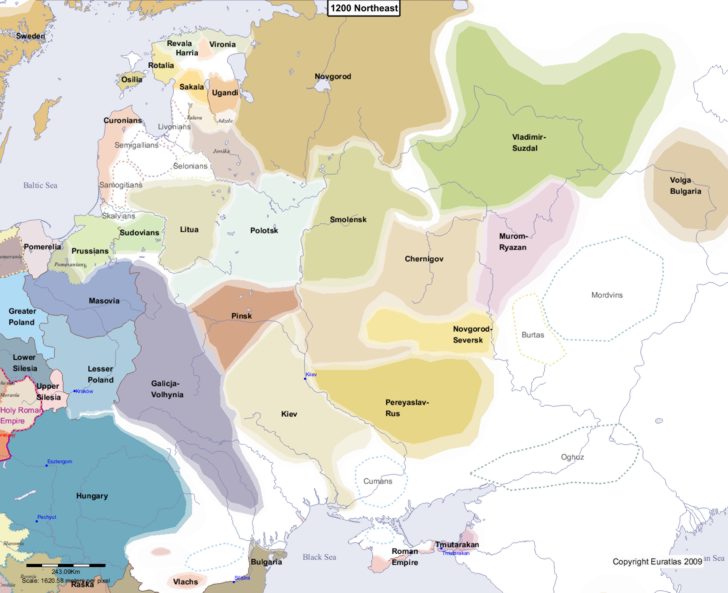
[The people of Livonia received the good news several times over. The first time probably was the attack of the Teutonic Knights under the flag of Neo-Christianity on Jersika in 1209. There are several contour maps of such forced conversions available. One is sketched right here by these blogs of course. There is also the so-called “Bloodlands” (click on ‘audio' version.

In 1209, Bishop Albert of Riga, attacked Jersika (Vis=All; valdis=ruler). The bishop defeated Visvaldis, brought him to Riga, humiliated him before the public, took away most of his land, and sacked him beyond recovery when he tried to rise a few years later.

The attack on Visvaldis coincides with the crusade of the Pope Innocent III against the Albigensians in southern France in the same year, 1209. While it is unlikely that seven hundred years later we will discover a label with “proof” written on it, it is equally unlikely that the date of attack was an accident.

1209 was a fateful for the Latuous or Latvos. The land Jersika was heir to was seized by a neo-Christian crusading order, the Teutonic Knights, and added to territory called Livonia. This land has remained out of reach of its natives to this day if one includes among the natives the common people. The Commons or Populists were and are kept in the dark. One but has to note that the founding event of modern Latvia (1918) had only one photograph of it made public, and the future president was not in attendance at the founding event. Like the “Lihgo” flag, the avoidance of mention of these details obscures the fact that the Constitution of Latvia (Satversme) was never designed to facilitate greater hegemony.

In any event, 1209 was a time when Livonia was covered by forests (today Latvia has no original primal forest left), and the Jersikans had no problem disappearing among the trees. Pursuit was difficult if nigh impossible, because in those days there were no roads or bridges, only waterways.

Before the attack from Riga, king Visvaldis had been in a strategically advantageous position. His kingdom of Jersika straddled the River Daugava, and he taxed all the boats and ships passing through. Indeed, if the reader takes a closer look at the map, he-she will note that access to Riga and the bay to the people of Jersika is cut off as if it has been taken from it. In other words, Riga most likely was not founded on unoccupied land or over a fishermen’s village, but was taken from a people, many of whom lived far inland. Indeed, because of the higher water level in those days, Riga was located further inland, closer to what the map shows to have been the likely territory of Jersika.

We may guess that the inhabitants of Riga (or Līga) before its occupation were—as most heads or deltas of navigable rivers tend to be—cosmopolitan, mixed blood, livs, ests, semigalians, latgalians, slavs, and so on. They do not appear to have left much evidence of their times. However, if they were living in wood shacks (at that time the forest engulfed, indeed was identified with the land), they probably lived along the banks of the Daugava River.

The theses of what happened to the inhabitants of Jersika or the Jersiks leaves us entertain the idea that the descendants remained in the same geographical area. The Livs were effectively wiped out only by the Great Northern War (1700-1721). Very likely some Livs were among the Herrnhuters who wrote Ludwig those nice letters about identifying so much and sincerely with the blood of Jesus.

The landscape of Livonia began to change dramatically only after the 16th century. The Latvians today like to call themselves a peasant (zemkopju) nation. Nevertheless, the time the Latvos could legitimately call themselves “single farm” (viensēta) dwellers did not arrive until about the 16th century or later. It was about this time that the barons (they owned about 70% of forests in Livonia) cut down most of the trees about their manors and sold them to Swedish and other builders.

In due course, the Latvos were forced to become farmers and abandon their forest traditions  forest traditions. As a people deprived of a say over the fate of their forests, the Latvos became exposed and vulnerable to attacks by military drill formations, which on open field had the advantage. There was no longer sufficient forest left behind which a Latvos could hide and be on roughly equal terms with the enemy.

Had similar deforestation occurred in fledgling America, Paul Revere's famous ride would have ended in a New England ditch rather than New England farmers beginning a successful Revolution against the British and their redcoats. Interestingly, Paul Revere was the son of a French Hugenot. The name Herrnhuter and their activities in Livonia may not have been unfamiliar to him.

Asterisks & Links of Interest
Jaņdžs0 comments