Showing posts with label Latvian. Show all posts

Friday, August 26, 2011

Chickens Running in All Directions (XII)
Who is a heavyweight? I mean a heavyweight in a charismatic way.

I know that every star of whatever brightness is believed to be a heavyweight. However, this is a suspect presumption. The twinkle of a star may be but a twinkle.

The charisma of a heavyweight calls back to my mind the office of the Sacred King, the mythological, but not always, figure of ‘ancient’ times. This was a man, and sometimes a woman, who did real things in such a way that he-she earned themselves a place in a nation-founding myth.

Before the founding myth there was no Sacred King or Queen to guide society beyond the mother, children, and wandering Son circle. The members of this group were so much into each other that they seldom fought with each other.

Nevertheless, this incredibly tight knot, which was bound by incest [might this have been the original Gordian knot?] was often visited by exceptions: unforgettable murders. The murder by Cain of Abel belongs to this genre. The war between kings Paris of Troy and Menelaus of Sparta for the living body of Queen Helen was likely due to the fact that Helen’s bed was too close to that of her brothers. Such intimate relationships have long been erased from the founding story, whether the Bible or myth. Nevertheless, the story is a near perfect example of pareidolia http://en.wikipedia.org/wiki/Pareidolia in story telling. One may see this type of pareidolia as deliberate in order to facilitate the sometimes repressed mind. The ‘Mind’ of Western society fits the bill.
Due to the unwelcome outbreaks of murder among the ‘original’ family, a larger society—if it was to maintain itself beyond the immediate intimate circle for any length of time—needed to discover a reason for being. Why indeed not return to the warm circle of babies nuzzling the breasts of their mothers, the family where sex among its own is unavoidable?

There are two ways in which an incest ridden family can avoid future outbreaks of fratri-cide.  One is 1) to leave the murderous event, the horror, and prevent a recurrence of itself as long as it remains part of a society’s living memory, but thereafter risk a repetition; or 2) repress incest.

The repression of incest fell to the office of The Sacred King.

The Sacred King did not repress (as we may think today) by using the police or a military, but by offering his life to death. By giving (voluntarily) his life to death, the king creates for ‘death’ its large D. The Death of the Sacred King creates such charisma that it equals and passes the charisma of two brothers trying to slay each other.

In other words, Why us, why is it that we must die, but not them; or why we and they, but not they over there are dying?

The cause of an enlarged social space is stimulated into being by two powerful factors:  1) the fact that sooner or later a murder not only does but must occur; and 2) that without a mediating resource, the default will prevail; in other words, catastrophes of a tragic nature will be frequent. Brothers will kill brothers as if no sisters had been born. Incestuous dreams lead to incest, and death of one of the brothers will be by the hand of the other, who found his brother’s legs entwined with the same legs that bore them both.
The story of incest may seem far from the political economy of Latvia. Actually, it is not. Latvia is as every-where-else in the 21st century. The economic disparity between the two brothers, the Oligarchs and the Populists, puts them at a catastrophic distance from each other. While one brother is a Populist with little education banging a whore who is also a Populist and most of the time stays unemployed, the other has so much money that he is called an oligarch, and the government runs scared of his big D….  

This is how the big D is weighed: Death on the one hand, Dick on the other. Both names are heavyweight, but the last one is for a laugh, no?

In Latvia the two brothers represent the nature of Latvian politics. One is a ‘non-existent’ Populists dreaded by the Oligarchs, because they are but a handful. The first mentioned are many, the last few. The Oligarchs are believed to be omnipotent, because America, London, Paris, and Berlin are on their side, while the others are said to be mere Populists, a Mob of sorts.

The Populists are the jelly on which the Tower of Babel, today owned by oligarchs, is built. We know the Tower of Babel to have crashed http://www.deldig.com/media_thumbs/180.jpg at least once before. Will it do so again? Does not the World and Latvian media speak as one out of a given system beyond which there is no other?

One sees this polarized relationship between the oligarch who pretends to the Prime Minister’s job of Latvia, and Clever John and Crazy Jane, the last being witch Ragana’s eldest daughter http://esoschronicles.blogspot.com/2010/03/eso-antons-benjamins-aka-jandzs-not_26.html , the former her pimp. Like it or not, Clever John and Crazy Jane happen to be Latvian citizens, too.

What does one Lembergs do for an encore after President Berzins, who—before being stirred into a passion for his country by high office—receives the highest pension in Latvia? If Ls 5000 monthly were to be divided by 10, the result is Ls 500—which is to say that ten families could afford to return from England to Latvia or will not leave Latvia. Clever John and Crazy Jane (Gudrais Jānis un Dullā Žane) get screwed only the way an incestuous son of Latvia can screw them. Then the oligarchs have the gall to say that the Latvian language is the most holy, and go kiss their “D”s if you don't believe it.
The Middle Class, the “successes” from among the Populists are close enough to their Populist roots to appreciate the difference, and  continues to kiss the oligarchs’ Blarney Stone  http://www.irelandseye.com/blarney/blarney.shtm till it shines and right can no longer be distinguished from wrong.

Saturday, August 20, 2011

Chickens Running in All Directions (XI)

Let me begin this entry with Apollo, the Latvian internet site so frequently put down, because it best represents populist resentment of Latvia’s corrupt institutions. The site speaks for itself by shouting loudly, clearly, and sometimes in a foul language the opinions that infect the populists. By populists this writer means that segment of the population without which democracy is not possible.

Speaking of democracy in Latvia, were it to exist here, there would be no public displays of the Turrets’ syndrome that infect the responses at said site, but [to paraphrase Adrian Kuzminski http://www.mdrtalk.org/ (go to ‘Populism, The Third Way’)] there would be a political economy of the people with claims to private property as a correlate to its claims to public power. In short, if Latvia were to be a democracy, it would use the leverage of its small size to seize for itself the intellectual ground that is that of the former Republic of Vermont (see above link) than ape the neo-liberal system that is visibly sick unto death.

Be that as it may, how does a country arrive at democracy when most of its authorities dream of becoming oligarchs, are oligarchs, or are in some way compromised by oligarchs. By using the word ‘oligarchs’, I mean not so much to put onus on the individual, but the system, re liberal capitalism self-regulating itself in such a way that there is in effect no regulation. A good example of this invasive power is the current President of Latvia, one Andris Berzins, an oligarch (granted, even by Latvian standards a minor one), who as a former bank director for an affiliate of a Swedish bank is blatantly compromising the economic interests of most Latvians.


In a recent media blurb http://www.apollo.lv/portal/news/articles/246875 , the President claims to know why the citizens of Latvia are unhappy with the Saeima, the legislative body of the Latvian government. The internet text is in Latvian, which may be as well, because were it in English, the reader would see through the clichés sooner than later and understand that the President’s ideas are simplistic and self contradictory. In this instance, a lie in Latvian obfuscates the lie more successfully than its presentation, say, in English, which due to its unfamiliarity to the public at large has less ‘white noise’ to interfere with the true interpretation of what he is saying.

In the media blurb, the President insists that he is a conservative to such a degree that he would not initiate measures without the full agreement of the Saeima (a body recently dismissed by voters as illegitimate). More over, President Berzins hopes that by presenting himself as such a conservative, he is not encouraging populism. (“…es kā prezidents atbalstīšu tikai tās iniciatīvas, kurām ir atbalsts koalīcijā. Ceru, ka tas nebūs pamats priekšvēlēšanu populismam”.) Apparently, the President is as confused about the meaning of populism as are most of Latvia’s political elites, which is to say, the President is just as interested in circumventing democracy as the dismissed Saeima. Not so incidentally, he is joined in his call for a special session of the old and discredited Saeima by the coalition of the Greens and Farmers (ZZS) http://www.apollo.lv/portal/news/articles/247227 , who are largely funded by an oligarch.

The other link that this blogger would like to mention appeared in Apollo. It is a summary of an interview in the newspaper Diena (13.8) with Valdis Birkavs.

Birkavs is a former Prime and Foreign Minister of Latvia. The text is in Latvian, and concerns itself with what Birkavs believes are the four stages of Latvia’s evolution as a state, re: 1) romanticism; 2) cynicism; 3) greed; 4) near hopeless confusion
http://www.apollo.lv/portal/news/articles/246776 In this instance, the Latvian text has no white noise.

Regarding the last and present stage of the government, Birkavs argues that after joining the EU and NATO, there began a period of indecision, aimlessness (for the last ten years), and standing in place. [“Līdz ar iestāšanos Eiropas Savienībā un NATO…. sākās periods… mētāšanās, bezmērķība [pēdējos desmit gados]… mīņāšanās uz vietas.”]

It is worth noting that Birkavs connects the deconstruction of Latvia’s sovereignty (see previous blogs) with Latvia enmeshing itself with EU and NATO. Joining the EU has cost Latvia its bright standard (spožo karogu) and surrendered it to Europe’s feckless http://dictionary.reference.com/browse/feckless politicians. This phenomenon has also been noticed by Philip Zelikow in a Commentary piece in the Financial Times http://www.ft.com/cms/s/0/e806c60a-c769-11e0-9cac-00144feabdc0.html .

Rounding off the neglect, both, of foreign and domestic policies in Latvia, George Friedman of Stratfor has much to say that hits the nail on the head, even though he writes of the state of the governments of the world and does not mention Latvia. Friedman is concerned over who are they who are presuming to be running the world? Are they not all lightweights? “The issue is: who are these people who are running things, what gives them the right to do so, and if that right does not somehow flow from competence, what does it flow from?”
Read more: Agenda: With George Friedman on a Crisis of Political Economy | STRATFOR
Which questions brings us to the question of who is a heavyweight?
I will attempt to make some suggestions in the next blog of “Chickens Running in All Directions”.


Tuesday, August 9, 2011

Chickens Running in All Directions (IX)

Judging by the ubiquity of the endearing word in the Latvian language (a number of languages share in this facility), a ubiquity that is now reduced to a potential rather than actual use, the proto-Latvians may be judged to have once been a peaceable people.

At some point in their history this peaceable people became subject to great violence. This violence appears to have been a prolonged affair, causing Latvians to become the victims of violence. That is to say, the victimization of proto-Latvians turned their descendants into a violent people as well.

If one follows Professor Rene Girard’s thesis  (this writer to a great extent does so), then the founding violence of the proto-Latvian community—that is to say, their recognition of themselves as a community through the killing of a scapegoat—occurred a long time ago. This initial violence through victimizing, likely, an innocent fellow human, was thereafter transformed into a profoundly felt guilt. Though, no doubt, I make what is known as a ‘forward looking statement’, it may be that the proto-Latvians projected their sense of guilt into their language. I.e., to avoid conflict among themselves, the proto-Latvians enabled their language to endear every noun and even soften verbs.

When speaking, the forebears of Latvians made the use of the endearing word a ritualistic practice by frequent insertions of words of endearment into their conversation. This practice reached a point, when such an insertion of endearments became automatic. This is a time when proto-Latvians and no doubt many of their neighbors created a unique not-violent http://esoschronicles.blogspot.com/2009/11/eso-antons-benjamins-not-violent-terror_25.html culture.

One may cite as proof of the endearing culture the fact that the Latvian language does not have such phrases of swear terms as “mother fucker” (widely used by the English speaking peoples) or “yobt via mat” (the same in Russian). Interestingly, the latter expressions belong to people co-opted by empires, which make frequent use of war and prepare their people for it by surrounding them with bare existence conditions. According to the generals of empires, the enemies of empires never value their life, which is, so to speak, ipso facto, why the enemy’s people fuck their mothers. The empires never have peace through conciliation or re-conciliation, but through violence. To the proto-Latvian mind this kind of behavior is a sin against human rights. Such swearing means that (in loose translation) ‘God fucks his mother!’ To imagine such a thing is not worth sacrificing the proto-Latvian language for.

Today the Latvian language is not yet a total sacrifice for the dump, but with the media and officialdom having largely eliminated the endearing word, the Latvian language is being presented as a kind of bastard that can be sold as a slave to whoever is the oligarch of the moment. And when a writer’s novel pays no more than a few hundred lats, it leaves the language to the publicity pimps, who are this very the moment pimping it for whatever it is worth. It is known as the positivist mode.

When I (LOL) laughed out loud that Latvia had become an Administrative District in the European Union, I found it more than funny that the first bureaucrats administering the district are foreign bankers even as they play footsie with proxies like the President and Finance Minister of Latvia.  

In short, dear Latvians, the administrators predicted by ol’ George Orwell in his novel ‘1984’ are our overlords. We share them with their equivalents in Greece, Ireland, England, France, Germany. In fact, they are all over the world.

This then comes to the question whether Administrators have the right to send people, any people, to war? Can those, who guarantee themselves death in a down bed, send others to die in their place in wars they have declared? Can the President of Latvia be among the receivers of the highest pensions in Latvia? By what right does a foreign proxy send Latvians to war and leave men who hardly have visited Latvia decide Latvia’s domestic and foreign policy? Is the foreign policy of Latvia anything but a charade?

Talking about a charade—is not the tiff with Russia over whether Latvia was “occupied ” by the Soviet Union (1939) based on the (unspoken) fact that President Ulmanis offered the Soviets no resistance, but knowing that resistance was futile, did not offer his own life in lieu of it and as an affirmation that it was not futile? Did Latvia avoid becoming an administered district of the Soviet Union by offering no resistance to it?

If the Latvian legionnaires who joined the Germans against the Soviet Union in 1941, whether they volunteered or whether were conscripted, did so for patriotic reasons and in defense of Latvia and the Latvian community, did they also not step into Ulmanis do-nothing trap: Ulmanis did not re-found the State of Latvia by giving his life for it. He left the community fend for itself. The community, left without leadership fell into a legalistic trap: try as they may, they cannot extricate themselves from accusations of being trusted by the Waffen SS and all it implies.
A great many Latvians died, were sent to Gulags, fled to near and far abroad, but are not requited by the government of Latvia with a government that knows what it is doing.
#
The following article by George Friedman at Statfor is an excellent summary of the political-economic situation in the world—not excluding Latvia.

Saturday, July 30, 2011

Chickens Running in All Directions (V)

The Latvian people have a saying that—to paraphrase—goes something like this: “We Latvians are a hardy people. We have survived many catastrophes before; we will survive this one also.”

What the people forget is that the origins of the phrase come from a forest and agricultural society, a society that is no longer in existence. Though the Latvian people have indeed survived many catastrophes in the past by hiding in the forests, today most of the forests are gone and the people have been driven off the land by modern technology and the requirements of market mercenaries. While in the past one could hide in the forest and survive on game and the milk of a cow, the same people today have been forced off the land into an urban society.

Forcing the people off the land is not a new phenomenon in the world or in Latvia, but in Latvia it has taken its most dramatic turn during the last twenty years, the very years since the renewal of the Latvian Republic in 1991. Worse, the Latvian people have not migrated to Latvia’s urban centres, but have bypassed these by moving directly to foreign lands. The abandonment of Latvia by its own has never reached such numbers before. While the precise figure awaits reports from the Census Bureau, the loss of people to Latvia is estimated to be anywhere from 250,000 to 500,000; in short, about 20% or one fifth Latvians have gone abroad, most of them for good.

Given that the demographic loss has happened accompanied by silence, with the Latvian government giving the phenomenon no attention except for the last year or so, and the Latvian media taking its cue from the government, the knowledge of events and trends by the majority of Latvians is notable for its absence.

In effect, while the Latvian government takes umbrage from criticism by insisting that it is the mirror of Latvian society (you get what you elect), it is the Latvian government that imitates a democracy of chickens let roam the field. It is freedom embodied in anarchy. Given the absence of a rooster and an experienced farmer, the hens and the chickens soon become pray to the first hawk to notice them.

The hawks that noticed the Latvian chickens first were foreign banks. Seeing that the government of Latvia was acting like a rooster without a head (in effect, leadership has been nonexistent), the hawks dove for the Latvian pocketbooks. While the robbery did not occur in broad daylight in order to avoid legal complications, it occurred by a sort of paradox: the foreign banks deliberately loaned the Latvians more money than they could repay, even as they knew repayment was legally binding, and would be enforced by such institutions as the International Monetary Fund (IMF) and the European Central Bank (ECB).

The logic of the manoeuvre by the foreign banks somewhat resembles that of a shrike impaling a mouse (the logic is of course not that of a shrike, but entirely human): See, I am not eating the mouse raw, but I am impaling it http://www.youtube.com/watch?v=Zq8MAEBP8Ac in order to marinate it in legal chicanery. Or to put it another way: Look, we are not depriving the Latvian people of their sovereignty; we are letting them cook in their own juices before we come to eat them.

The example of the bank shrike’s way with the Latvians (surely an ethologist’s http://en.wikipedia.org/wiki/Ethology observation) is a good place to insert another observation by Rene Girard (see previous blog) concerning the uses of stones:

“The reduction of canine teeth to their current dimensions occurred a long time before the appearance of homo sapiens, suggesting that stones had replaced dentition in most of their uses, including inter-species combat.”

Peace is not however at hand. Girard continues: “Animals are capable of engaging in rivalry and combat without fighting to the death because instinctual inhibitions assure the control of natural weapons, the claws and teeth. One can hardly believe that the same type of control was automatically extended to stones and other artificial weapons the day that hominids began to use them. The violence that goes unchecked by instinctual inhibitions… will become fatal the moment these same adversaries are armed with rocks.”

What makes Rene Girard’s work interesting is that through a combination of ethology http://en.wikipedia.org/wiki/Ethology and
ethnology http://en.wikipedia.org/wiki/Ethnology , he perceives coming into being  a uniquely human culture of, if you will, mimetic diasporas. To put it in another way, Girard enables us to see how from the actions of the shrike and the users of stone, we arrive at the rigid symbolic rituals of early hominids, from which—in due time—arises the symbolic framework that allows human beings to engage in mimetic rivalries that the rigid rituals of earlier times forbid.

However, the increase in mimetic rivalries brings with it an increase in crises that lead to violence. According to Girard, such violence could be averted only through the mechanism of finding a scapegoat, which was then murdered by the whole community participating to preserve communal peace. This is why [see previous blog (V)] the first human pyramid was the result of a stoning of the scapegoat. It was through such sacrifices, which averted greater communal conflict, that there arose what we today call a complex society.

Let us now think back to the actions of foreign banks in Latvia, and of similar actions by the banks in Greece, Ireland, Iceland, and others. Though these actions are camouflaged by legalisms, they have brought Latvia (and others) to an existential crisis. Does this not suggest that we are living at a time that is looking for a scapegoat?
However, if scapegoating is a matter of times past as many allege, then what is the mechanism by which it is to be averted?

Sunday, January 2, 2011


The following blogspots center on a variety of subjects, which I have initiated. You are invited to look and respond.
http://esoschronicles.blogspot.com/ Not-Violence main subject
http://melnaysjanis.blogspot.com/ Temple of Janis (John) site
http://the-not-voter.blogspot.com/ Arguments for systems change
http://the4thawakening.blogspot.com/ Sacrificial crisis in Latvia

I suggest you look at the links imbedded in these blogs or at the end of the blog as an integral part of my argument.
The 4th Awakening
26 Watching a Language Being Lost (1)
© Eso Anton Benjamins

The mission of the Latvian language is implicit in its unique pietist foundation. Pietisms, reverence for life, animate and inanimate nature, and gentling are all part of the “weak” force that labors to turn the Earth’s habitat into a more livable place.

To the Latvian baby along with the mother’s breast comes a language its forebears fashioned to feel themselves welcomed into the world of nature, too. Thus, a stone against which I may lean my back against is no longer a mere stone, but a “dear stone”.

Pietism distinguishes the Latvian language by means of enabling its users to turn every noun into an endearment real or ironic. Through the Latvian language a Latvian gives evidence to a mindset that disputes the aggressive and mercantile Zeitgeist of our time. No doubt, this linguistic facility may be ignored; and today we live in days when it is ignored. For that reason, we may say that today the Latvian language is half of what it can be. The missing half cannot be replaced by advertisements showing pretty nature pictures with few or no people. This harsh and at the same time slick meme, which has occupied the mindset of Latvian media, bureaucracy, government, and much of private communication on the internet defines our times,

We have a good example of what a wholistic language ought not to be in English. Whether English words acquired their clunky-ness as the result of the Great Vowel Shift that took place in the 15th century and practically speaking destroyed an earlier poetic tradition may of course be debated. However, by way of example, we may note how the word Sonne (the Sun, feminine gender) was turned into the sun, masculine gender, with a small s. In German, the sun is still die Sonne, and it may be endeared as when we speak of it as Sonnchen [Saulele (Prussian), Saulīte (Latvian) = (Sonnchen; saule=Sonne), die Sonnengoettin, Saule, the Dearest Goddess].

It may seem a paradox to some that on the one hand I urge Latvians to learn to speak and write English; on the other hand, suggest that the Latvian language is more relevant to our times than English. What is the reason for such apparently contradictory advice?

The paradox is of pragmatist origin. English, the language of expedience when it comes for two or more people born to a different language, to communicate, is one of the most widely distributed languages. It is also—as per the Great Vowel Shift—a hybrid and a relatively recent language, and, thus, in many ways an academic language. [No, I am not contesting American country music, but if left to itself, it would probably revert a la populism to a form of profoundly emotive speech.]

The arrival of English is intimately linked to the bastardization of democracy by political science and the arrival of the Magna Carta, the latter a document limiting democracy for the forest dwellers (the forest cover necessary for true democracy was fast disappearing at the time), and increasing it for secular princes and today’s oligarchs.

At the time of Chaucer and his “The Canterbury Tales”, the poet had three languages to choose from: Latin, French, and Middle English. Chaucer chose Middle English not only because it was the evolving vernacular of those who lived about London, but the poet’s own intuition of the way the tilt of the Vowel Shift would lean. One may imagine that the poet had a meme that had followed him (who knows through what labyrinth) and was developing an increasingly powerful charisma.

The charisma, in this instance the attraction of clunky words, was sufficiently strong to attract not only Chaucer, but to turn out to be the call of the future. Perhaps one of the causes of this meme was what one may call the “galloping” mindset. There are no memes of endearment to interfere with the academe when it comes to enlarging the classification and filing system. Like violence, clunky words have no bars to hold them back. Dissed emotion checks neither violence nor greed unless one pays with one’s life for it.

In other words, violence and freedom (to be greedy or whatever) belong to the same meme. Both are elements belonging to the great wilderness, to nature unrestrained. They are the syndromes that remove all obstacles— children including.

The Latvian language (valodiņa) [Vaidelotis = singer = moan = ruler = priest = male witch = wound = fault …], on the other hand, carries a “weak” meme. The language is able to endear everything about it, and if the endearment seems to be questionable, then surely it speaks in irony. Today the posts on internet sites, if not blocked by some computer activated editor, are a river of plastic bottles, rotten oranges, condoms, and misplaced flowers. This froth of rubbish is said to be of the Latvian language. This is true because for the last one hundred years or more the endearing word has been relegated to the barn or garage. The children who are born today receive in school lessons in sanitized Latvian, i.e., Latvian sans the endearing word. The secularist catechism is no longer an overtly a religious script of neo-Christianity, but comes to strip the language of its native and spiritual meme all the same.

The immediate blame for the demoralization of the Latvian language goes to the Latvian government of the past twenty years. This is to say, the blame is with the post-Soviet-Latvian government turning the language into a rag for its own purposes. In hind sight, the Soviets were kind to the language even if everyone had to speak Russian. Bleaching words like rice and then sowing freeze dried white rice in the nation’s garden is of positive advantage to those in office. Positivism recited by rote, with not a gram of self-sacrifice or endearment to pepper coming with it, drives the Latvian language and the people behind the language off the bridge. Never mind. Every bureaucrat and politician continues to wear a look of saintliness as if nothing happened.

The government keeps the undercurrents of the Latvian language, some would say the real language, the language with a mission, out of everyone’s field of attention. While the word ‘government’ has beneficial connotations, the Latvian government’s embrace of the Latvian language as a matter of identity is smothering the real function of the language—its mission, its vision. Such behavior brings one to the conclusion that what is happening is a hiding of the death of the Latvian language—if not actually desired, then not opposed either.

For how long can the government defend the Latvian language and hope that no one will notice that its failure as government is complicit in the exodus of Latvians to foreign lands? Conservative commentators observe that over 12% of Latvians have left Latvia for jobs abroad. That is 12% out of an estimated total of 2.3 million people; that is ~ 250,000 people conservatively. Other figures suggest that 340,000 340,000 have left. Some may think 500,000. These are not census figures. The census may double that figure.

Now for a quick return to

The Story of Crazy Jane and Clever John, Part 3 as retold by
© Eso Anton Benjamins (…story begins at blog 15)

It so happened that King John I was taking a stroll through his garden and saw Clever John arrive. He and his mare looked like they had ridden through an apocalypse circa 1492. That was the year for which the Apocalypse had been written six years before. King John himself had commissioned the work and was happy enough that the astrologers had got the year wrong.

King John I walked up to the gate. His guards were about to seize Clever John for a vagrant, except his bear skin coat and he stunk like a real bear. The moment the guards saw the king, they sprung to attention and gave a salute. “Hail King John I,” they shouted.

“A good Sunday,” said King John I. “Who have we got here? Is it another cricket bather?”

 Clever John did not wait for the guards to speak, but spoke first. “King John I,” he said, “I am just from Sun Mountain and a visit with the Sun. The Sun sends her greetings.”

“Why thank you,” answered the king. “I have visited the Sun also. I know how hot it can get there. By the way, what is your name?”

“I am Clever John,” answered Clever John. Just as he said it, he noticed that King John I did not wear a golden crown as he had expected, but that his toe nails were uncut, long, grey and curly. Clever John had heard that rich men could afford to look however they wanted; on the other hand, if the guards had not saluted him, he would not have believed the king to be king at all.

“What brings you here, Clever John,” asked the king.

“I have come to ask for the king’s daughter,” answered Clever John trying not to look at the king’s toenails.

“What a great idea, Clever John,” answered King John I, “however, no one can have my daughter without first bringing we a wagon full of gold. Do you have such a wagon or do you believe that you could find one?”

(To be continued. Part 3 of story.)

Asterisks & Links of Interest

Unchanged Feature: The Witches of Ghana in Gambaga
Could we have the name of Ghana pronounced as Yana? If so, could we then call the withches Yanas (Janas, Zhenas) of Yana (Jana, Zhena)?

Unchanged Feature: What is reality, what is myth?

Changing Feature: In the preceding posts, I started a compilation of a series of video clips, which when seen as a linear sequence tell a story in a telling context. This is a continuous story. If it began in the past, now it is moving parallel to the day we live. Note what is happening around you. Put this clip as a tail to your blog http://www.youtube.com/watch?v=4CkXhtw7UNk&feature=related so others may see. The origin of this post is at http://the4thawakening.blogspot.com/ 

Friday, December 17, 2010

Full or partial entries of my blogs may be found at LatviansOnline http://latviansonline.com/forum/ + Forum Home + Open Forum – The 4th Awakening. If you copy this blog for your files, or copy to forward, or otherwise mention its content, please credit the author http://esoschronicles.blogspot.com/, http://melnaysjanis.blogspot.com/, http://the-not-voter.blogspot.com/ or http://the4thawakening.blogspot.com/

I suggest you look at the links imbedded in these blogs or at the end of the blog as an integral part of my argument.
The 4th Awakening

21 The Clerics Win a Pyrrhic Victory

The Herrnhuters were repressed to put a stop to rising self-consciousness among proto-Estonians and proto-Latvians.

While some historians say that the Herrnhuter movement came to a halt effective 1840 (due to running out of steam according to some), my great-grandfather and others kept it going in the Vidzeme part of Latvia. In my great-grandfather’s case, he kept the Herrnhuters active in the vicinity of Taurene, Bānūžu Manor, where he was manager. Interestingly, his title was not that of ‘vagars’, a name often associated with brutal overseers of farm workers, but ‘starasts’, the name distinguishing the bearer as one worthy to be ‘star east’ or the star of advent). Even after the inn he leased (Mūru krogs) was burnt down in the early 1860s and after he died (1868), he was remembered by the local people as starasts and his wife was referred to as the wife of starasts.

As I have mentioned in blog 8, the inn may not have burnt down (as told later) as a result of my great-grandmother making candles over a hot kitchen stove, but as an act of arson by forces unknown to stop this one Herrnhuter lay preacher who would not quit preaching.

Like many violent events that for one reason or another go unrecorded and receive interpretations contrary to fact, the blame for the burning of “Mūru krogs” inn was passed to my great-grandmother. She kept the secret by saying nothing. One reason for thinking that she was not to be blamed for the fire is that she is not known to have ever blamed herself for it. The one comment she did make was that her infant son had to be wrapped in a sheepskin for lack of other garments. Apparently it was winter (perhaps before Christmas), because Abiņa is reported to have commented: “He (her son) was wee shivering”.

Grandfather also never blamed his mother for the fire, but collaborated in the lie (my assumption), because if one wished to get ahead in life in those days, one had to be a Lutheran and not a Herrnhuter. Even so, in his approach to everyday living—in spite of becoming a teacher and choir director with kudos, and later the founder and distinguished editor-in-chief of Latvia’s best known newspaper, grandfather ever stayed the lay teacher. One may presume that the latter is the reason why his relationship with the editorial staff of the newspaper and newspaper readers was never that of a cleric vis a vis church members, but a lay leader vis a vis a community. This is not to say that he did not have the occasional role of an intermediary-cleric (laity > cleric > God) between the newspaper staff and publisher, the latter the woman he married in a second marriage when he was past sixty.

That this kind of conflict (Lutheran vs Herrnhuter) may result in a misinterpretation of history is well known to Latvians who until twenty years ago lived in Soviet Latvia. This is to say that if under repressive circumstances one wished to get ahead with a career, at one time one had to be a Lutheran, at another time a Communist Party member.

Unpleasant and self-compromising compromises have dogged both proto-Latvians and their descendants to this day. In the case of the present, the role of the Lutheran clerics—a role the Herrnhuters were opposed to—has been taken over by the Latvian Saeima. In other words, where as the Herrnhuter order of the universe was man and Visums (or God), under the neoChristian order it was man > clergy > God. Today the clergy has been replaced by the parliament (Saeima in Latvian). Not surprisingly, in practice this order becomes that of a partidocratic democracy (=party democracy and/or partial democracy). The frequent observation among the public that the Saeima-Parliament legislates without a vision of a future for Latvia (and refuses to finance a study of alternative possibilities) is proof par excellence that the government at this time is an institution that exists only for the sake of itself and the interests of its lobbies.

The Pyrrhic victory (at least from my point of view) of the Lutheran church over the Herrnhuters in the 1860s had immediate and unanticipated consequences. Having brought proto-Latvians to self-consciousness, the repression of the Herrnhuters did not automatically effect the squelching of nascent nationalism and the repressors’ (tsarist Russia, German barony, Lutheran clergy) victory. Indeed, the repression turned into something of a paradox: the awakened proto-Latvians could be appeased (and fooled) only by replacing the numerous German pastors with Latvian pastors. Thus, we are now told that it was the Lutheran clergy that had such an important role in the development of national consciousness in Latvia.

Let us now return to our proto-Latvian story, which is a parable of the proto-Latvian Children of Johns become a fairy tale. It brings us once again to the subject of mimesis as desire, a very strange desire indeed, one which causes us to go hang ourselves over and over again.

The Story of Crazy Jane and Clever John, Part 2 as retold by
© Eso Anton Benjamins (…story begins at blog 15)

On the seventh day of the journey, Clever John—even as he came close to the foothills of Sun Mountain—was to see a most unusual sight.

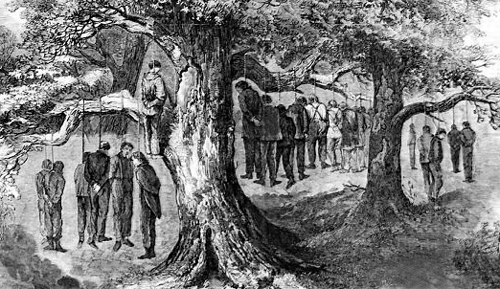
As Clever John and Rozinante galloped through forests and meadows toward the Sun, they went past a huge oak tree. The tree may have been a thousand or more years old. Its branches were thick and long. Resting on one branch that stuck way out was a ladder, and from the branch hung many nooses. All the nooses were filled, and from them hung many men and women.

As Clever John and Rozinante both stopped (no doubt somewhat taken aback by the sight), an ever greater surprise awaited them. The nooses around the necks of those hung loosened up as if by themselves, and the bodies of the men and women fell to the ground.

The bodies lay in a heap for quite a while, but then, unexpectedly, they began to stir and soon stood up. Everyone then went back to the ladder and stood in line to climb back up to the branch. One of the men came by Clever John, who greeted him.

“I am appalled by what I see,” said Clever John to the man.

“Don’t be so, Clever John. It will happen to you, too.”

“I dare say ‘never’,” answered Clever John.

“Time will tell, Clever John,” answered the man. “Nevertheless, you look to me like the heroic type, which is a sign that fame awaits you”.

“You believe that I should consider it?” asked Clever John as he tried to imagine the situation.

“There is yet plenty of time for it, Clever John,” said the man, “But tell me, where are you going?”

“I am going up Sun Mountain to meet the Sun. For five days she has hid her face. I want to find out what the problem is.”

“Ah, Clever John,” then said the man, “I beg you to ask Her for how much longer we must keep hanging ourselves?”

“Glad to do you the favor,” answered Clever John.


Asterisks & Links of Interest

Unchanged Feature: The Witches of Ghana in Gambaga
Could we have the word and name of Ghana pronounced as Yana? If so, we could then call the withches Yanas (Janas, Zhenas) of Yana (Jana, Zhena).

Unchanged Feature: What is reality, what is myth?

Changing Feature: In the preceding posts, we started a compilation of a series of video clips, which when seen as a linear sequence tell a story in a discernibly telling context. Note what is happening around you. Put this clip as a tail to your blog http://www.youtube.com/watch?feature=iv&annotation_id=annotation_994351&v=6pgRUpDDrb0 so others may see. The origin of this post is at http://the4thawakening.blogspot.com/  This is the 6th video of a series.
Jaņdžs0 comments