Showing posts with label populism. Show all posts

Thursday, July 14, 2011

Ding dong!
Who is there?
Ditch Zatlers!
Dill blossoms.

For the most part, there are two ways of playing “ding dong ditch”.

One of the ways is to ring the door bell and run. When the homeowner opens the door and sees no one, perhaps even walks around the house to make sure, the kids break out in loud laughter and run like hell to wherever they came from http://www.youtube.com/watch?v=jVjIRHlobFw&feature=related .

The other way is to ring the bell, and when the owner opens the door, he finds himself facing Ra-gana, the old Halloween witch, who screams: “Trick or treat!” The word “trick”, if taken serious, means: “If you don’t give me candy, I will whack you with my broomstick” http://www.youtube.com/watch?v=DSY2f2Wt9BU&feature=related .

More dill blossoms.


There is also the Zatlers’ way. You go to the door, ring the bell, and when the homeowner opens the door, he, Zatlers, surprises me and says (not really, but in my/ our imagination): “I suggest that the time has come do dismiss the Senate. On the 23rd of July, there will be a Referendum, when you can vote and tell me and everybody whether you agree with me and everybody or no.”

When the ding dong (me and you) heard Zatlers message, he-she yelled “Līgo! Līgo! I love you, Zatler. Right on! Out with the crooks! Līgo!”

“Good,” says Zatlers and closes the door.

The ding dong then says to him-herself: “This is wonderful! Those lawmakers have been stealing and selling Latvia off bit by bit to foreign banks. Here, I am near telling Latvians to lease Riga to China, so that after selling off Latvia, we are not asked to yet thank them. At least if China leases Riga, say, for a century, Latvians will be debt free and start a new life. In return for our liberty, we are ready to start out with a straw roof in a forest home, and nothing much more than a coconut or two to chew on. ”

However, your thrill quickly evaporates.

At the edge.

After knocking on every door on your street and telling every homeowner what you have just been told, the whols street awakens and whoops it up, or as the Latvians are wont to say "go Līgo".

However, after closing the door, Zatlers goes eats his supper, and goes to sleep. In the morning, after he wakes up, Zatlers has breakfast, speaks with his press secretary, who then goes out on the front porch of Zatlers apartment. Thence she announces to reporters standing around in the yard waiting for Zatlers to make some further thrilling announcement.

Zatlers’ Press Secretary announces that Zatlers is forming “The Zatlers’ Reform Party” (ZRP) http://www.apollo.lv/portal/news/articles/243786?ref=theme. “Zatlers is the first and until now only Latvian politician since Latvia renewed its independence, who has decided to take such a radical step by opportuning the people to activate themselves and not permit [the Saeima] to repeat earlier mistakes.”

Zatlers Press Secretary goes back into the apartment and finds the former president is fast asleep on the couch. She awakens him and asks: “Anything else, sir?”

“No. Thank you. That was great. We are on the roll now.”

“Yes, sir, I understand. However, should we not now get together a band and march down the streets of Riga and byways of Latvia and trumped and get out the vote for the July 23rd Referendum?”

“I do not believe so,” answered the new political hero. “We are not populists.”

Climbing up my legs.


“But, sir, it was the populists who thrilled to your message. You should take your advantage and fire them up to go and VOTE!”

“I do not wish to repeat myself again,” said the New Hero. “I am not a populist. I believe that populists are communists, or fascists, or chauvinists, and who knows who else. They are no better than the crooked Saeima.”

“Who then will be the voters?” asked the Press Secretary.

“Latvians, of course.”

“Well, yes, sir, however, what if all Latvians—except government employees and media people—are populists?”

“That cannot be. Latvians do not like populists. No Latvian ever says a positive thing about them.”

“But, sir, I read that without populists there cannot be democracy. Besides, you are moralizing. Moreover, here is one Chantal Mouffe http://en.wikipedia.org/wiki/Chantal_Mouffe , a political scientist, who writes that “….moralization of politics leads to the emergence of antagonisms that cannot be managed by the democratic process…. It is clear that when the opponent is defined in moral terms, it can only be envisaged as an enemy, not an adversary. With the ‘evil them’ no agonistic debate is possible.” [See: "The ‘End of Politics’ and….]

“She is a Marxist. The two things that Latvians like least are Marxists and Populists. When in Latvia, we must think like Latvians do. I am a Latvian. Few Latvians are ever Marxists. It is for sure that no Latvian can be a Populist.”

“Alright, sir, however, there is no campaign going on in Latvia to turn out the vote on Referendum day, July 23rd. We are missing out on a great opportunity to stir the Populists, the (presumed) majority of Latvians. Not since the rebirth of Latvia, sir, has anyone been as brave as you. Lead on, sir! Lead on! Time is wasting. Make noise, sir! Trumpet and repeat the reasons for the dismissal of Saeima.”

“I cannot do so until after the Referendum vote happens.”
In the wink of an eye.
“Why not, sir?! Do you think that selling off Latvia to foreign banks is only a ‘mistake’? Perhaps the Latvian people think that it is more than a mistake. What do you say to Ernesto Laclau http://en.wikipedia.org/wiki/Ernesto_Laclau , who insists that “…populist discourse does not simply express some kind of original popular identity; it actually constitutes the latter”?  How will you ‘reform’ without knowing what the popular identity of the Latvians is, sir?

Sunday, June 26, 2011

The President-Elect of Latvia, Andris Bērziņš,
must question the validity of his election!

The last knot

The most obvious thing that can be said about the outgoing President of Latvia, Valdis Zatlers, is that he is a sentimental http://en.wikipedia.org/wiki/Sentimentality man. To quote from the link: “…current usage defines it [sentimentality) as an appeal to shallow, uncomplicated emotions at the expense of reason.”

To be criticized for being sentimental does not mean that one questions the patriotism of a patriotic sentimentalist. I do not doubt that President Zatlers is patriotic. However, I do question whether the President—overcome by sentimentalism manifest as inaction—has any sense of what it takes to set the State of Latvia upright again and unify the people who constitute the body of the nation known as Latvia. In effect, I question whether he knows the reasons why for the last four years, he was the President. The public knows, he has struggled with himself with that question. There are some positives.
Indeed, Presidents Zatlers ma
de himself noteworthy when a few years ago, following a demonstration now known as “the umbrella revolution” (also “the 13th of January demonstration”), we heard him vow to ask for the dismissal of the legislative body of Latvia, the Saeima. The President appeared to have overcome his sentimental feelings about the future of Latvia in favour of action. The People would vote on the question in a Referendum or so they were in anticipation of.

Unfortunately, the President reneged on his promise (call it an implied promise), until only a few weeks ago, near the end of his presidential term (it did not look that he would receive the necessary votes to be re-elected to the next term), on the 28th of May, he made his promise to the demonstrators on the 13th of January, 2008, real http://www.youtube.com/watch?v=mT6944am6IY and asked for the dismissal of the Saeima. If the majority of the electorate agreed with him (in a nationwide Referendum to be held on July 23), then came September 17, there could be popular elections for a new Saeima.
Checking it out

The immediate reaction from the public was ecstatic. Many still are to this day. Nevertheless, the anti-populist voices in the media reacted and were heard almost immediately.

Populism was derided on all fronts. The very force, the popular sovereign, to which the President had just made his appeal ti, was derided as undesirable, surely a constituency of irresponsible elements. The Latvian media breathed the wrath of liberal capitalism. It never mentioned that behind it stood the ad man in the service the so-called  ‘oligarchs’. One show (Jaunā nedēļa / The New Week), made it a point to deride “populism” by declaring itself against it more than three times in rapid fire succession, then filling the other half of the time slot for the show with a pro-nuclear video analysis of Latvia’s future energy needs.

Note that in the Latvian President’s speech (click above link), President Zatlers gives a long list of decisions by the Saeima detrimental to the future of the Latvian State. He begins the list with the Saeima refusal to confer the authority of the “Generāl-Prokurators” of the State to the man chosen by the Latvian equivalent of the Supreme Court in the U.S. (Augstākā tiesa), and ends by mentioning the Saeima acting on behalf of certain private interests and of putting the State in danger of being privatized.
Volodya and Black John

As President Valdis Zatler’s predicted, came June 2nd, the Saeima did not reelect him, but in his place elected a flower on the wall, a complete surprise to the popular sovereign public, one Andris Bērziņš. A former banker, a pensioner drawing the highest pension of anyone in Latvia, a Don Juan of sorts, this narcissist had to yet try becoming the President of Latvia. And the Saeima gave him his wish.

One would think that the popular sovereign public and President-Elect-Out-of-Office would scream foul. What is wrong with calling for President-Elect Andris Bērziņš to refuse to accept his election as valid, and have him and President Zatlers call for an immediate popular elections of the President?

–even if the Constitution does not provide for such a course, and “there is nothing juridicially wrong” with a corrupt (and dismissed) Saeima projecting its corrupt seed onto the future through Andris Bērziņš.

The argument that the election of Andris Bērziņš to the Presidency of Latvia is a corruption of the spirit of the dismissal of the Latvian Saeima by the popular sovereign is surely valid. One may argue about the issue, but one cannot silence it. Mr. Andris Bērziņš should reflect twice about his vainglorious ambitions.

President Valdis Zatlers, on the other hand, ought to forego a farewell garden party and make an outright appeal for President-Elect Andris Bērziņš to refuse to accept the Saeima’s election of himself as Latvia’s President—the day after the public votes in said Referendum to dismiss the existing Saeima from office. To not do so and choose a garden party is choosing to be sentimental.

Thursday, June 23, 2011

Johns Eve, June 23, 2011

Johns grasses


The Latvian politologues, a term suggesting political expertise, but in fact being a term applied by hosts of news shows to anyone he-she pleases to so elevate. Judging from the stuff that Latvian politologues say and opine, most of them have some education in the art of politics. However, none of them has heard (at least not in Latvia) of the word “populism” as a term that plays a significant role in the politics of just about every country but Latvia.

This matter of the “populists” and “populism” being a word beyond ken is another matter that causes Latvia to distinguish itself as an exception among nations.

If the government in North Korea is sometimes thought of in terms of being brutish and nasty, and those damn landlocked Afghanistan’s are unbeatable because of their populist notions of themselves, and add those commie populists who brought on the Soviet Revolution, and the poor and unemployed Germans following the First World War with their load of reparations to pay, and one soon comes to the Latvian notion that the word “populist” is not mentionable as having any sense of meaning, except contemptible.

Such notions concerning Populism pervade the Latvian establishment from the President down to every talking head on television. Apparently no Latvian politician when engaged in protecting his moral image through self-gratification can see in his dreams any other woman than a breasty half naked Dame Liberty with raised sword leading the rabble into battle against “talking heads” of Latvia. Populism is, in short, an unmentionable mentionable, a synonym for protecting the existing political system from politics.

Little Jane

As I suggested in several preceding blogs, the Latvian President-Elect ought to refuse to accept his election as the next President of Latvia by parliamentary Saeima (a Senate sort of), which the incumbent President (in office until July 7) has suggested be dismissed (for any number of anti-State acts) through a public Referendum to be held on July 23.

I have also suggested that such a refusal by the President Elect is desirable, because it is likely to have the effects of a religious revival, i.e., it will bring Latvians another step closer to the re-founding of their nation. I stated that in spite of the legitimacy of Latvia as a state, there are certain questions that refuse to go away. One of these questions (because it is being treated as if there can be no such question) is why the Latvian government—ever since the declaration of Latvia as a State in 1918—has tilted center-right?
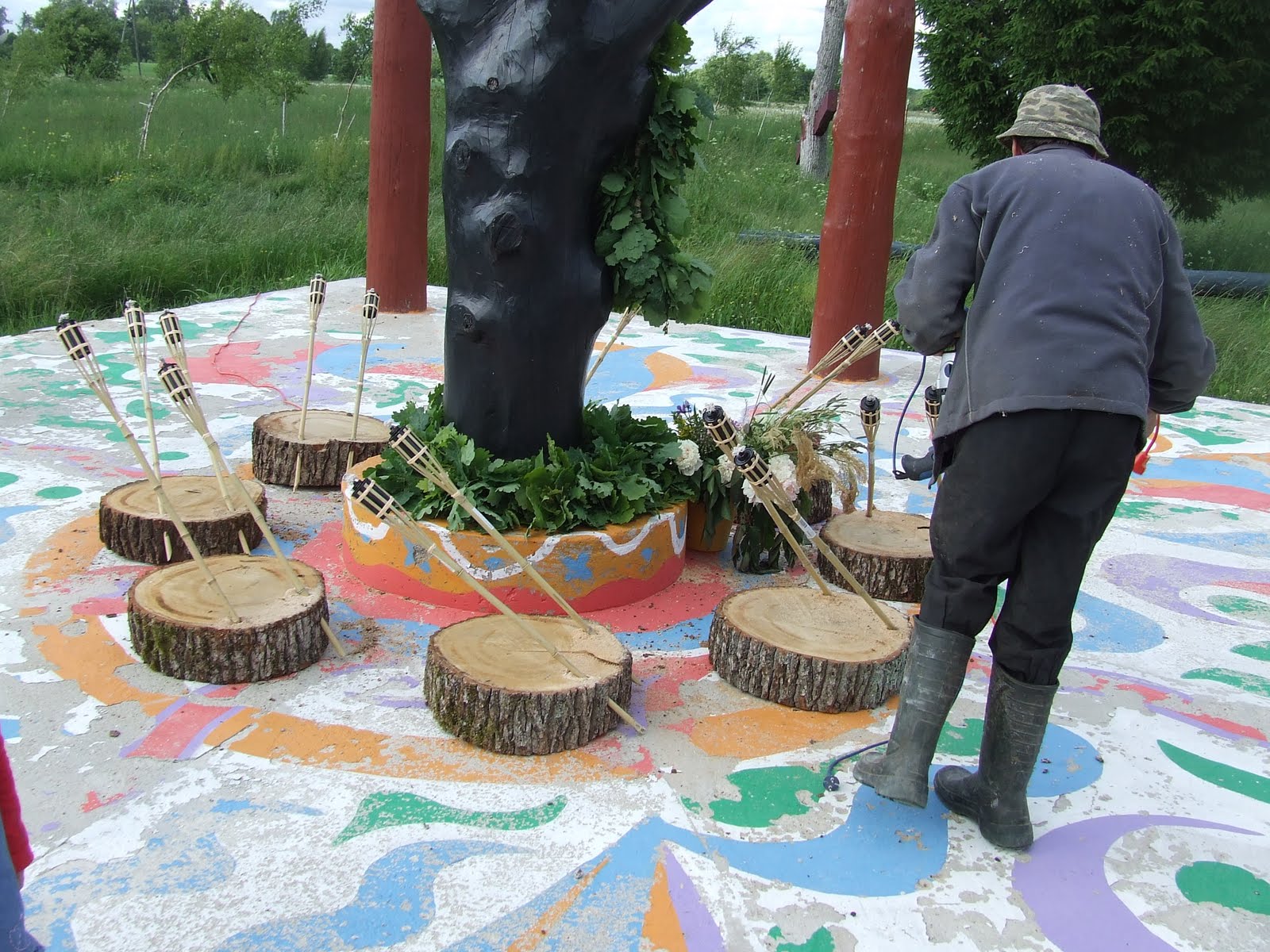
Making the Johns crown (vainags)

What is so right about center-right and so wrong with Populism?

There is a bevy of scholars, writers and teachers, whose contributions to political theory challenge the one sidedness of Latvian politologues and politicians. Here is a quote from Chantal Mouffe, a professor at University of Westminster: “The legitimacy of modern liberal democracy is grounded on the idea of popular sovereignty, and those who believe that it can be discarded are profoundly mistaken.” http://www.cccb.org/rcs_gene/mouffe.pdf

Apparently, Latvian politicians, politologues, and the media believe that “populism” is a word that can be discarded. A Latvian right center government has constituted the government of Latvia all the years of Latvian independence, except of course during the time Latvia was occupied by the Soviet Union. Moreover, the center-right—given that it has a mindset perpetually locked onto an Earth created in its image, re monopolar or a half a ball makes a ball—will always raise the question: “Hey, what about those popular sovereigns, err, those populists?”

In spite of questions, for most of Latvian politicos and ruling classes Populism remains something of a synonym for shit (sūds), which is why one may not hope that the President Elect Andris Berzins will voluntarily surrender his crown (bestowed on him by what the Populists call “oligarchs” and a partidocratic Saeima) of the Latvian presidency.

One of my unkind comments about Latvian oligarchs is that “oligarchs screw oligarchs”. Of course, oligarchs, i.e.—the system of liberal democracies in which individual rights have been secured by corporations—will likely prevail and maintain the democratic deficit in Latvia as it has for all these years. After all, it is private property over popular sovereignty, halleluiah!

In short, why should the President Elect not stick with the screws of the ship of state turning the ship in a perpetual center-right circle? Was the wheel not turned center-right from day one? Moreover, who can prove that the soft coup d’etad of “53+” was indeed a coup? It is unlikely that it can be proven in a juridical sense.
A son of Johns

However, the history of liberal democracy in Latvia tells a different story. Indeed, one may draw a parallel between de facto http://en.wikipedia.org/wiki/De_facto segregation in America after the Civil War (1861-1865) with regard to black people, which war allegedly freed them from slavery, but, alas, only in a de jure sense. Racial segregation in the United States de facto ended only a century later.

One has only to listen to the anti-populist, anti-popular sovereignty statements from Latvian government officials and the news media to know that the Latvian people constitute a segregated element, the Latvian democratic deficit.